Missed Nuance: Komaeda in Chapter 4
This article was originally in response to a question asked by an anonymous user. They wrote:
| "i did have another question about his lines specifically when he runs into hinata after the final dead room (the bits where he’s asking if hinata wanted to “become hope”) as i always thought that implied he knew he was kamukura at that point. and i want to know what he’s saying in japanese.
i’m also very curious about that line before the trial where komaeda is wondering why he still cares about hinata! if there’s any nuances there that are left out of the translation"
All English screenshots are taken from Hikkie's playthrough; all Japanese screenshots are taken from Quiet Game Archive's playthrough.
So, the part where Komaeda talks to Hinata about admiring hope is interesting for a few reasons...before we even get to the admiring hope part, Komaeda says this:

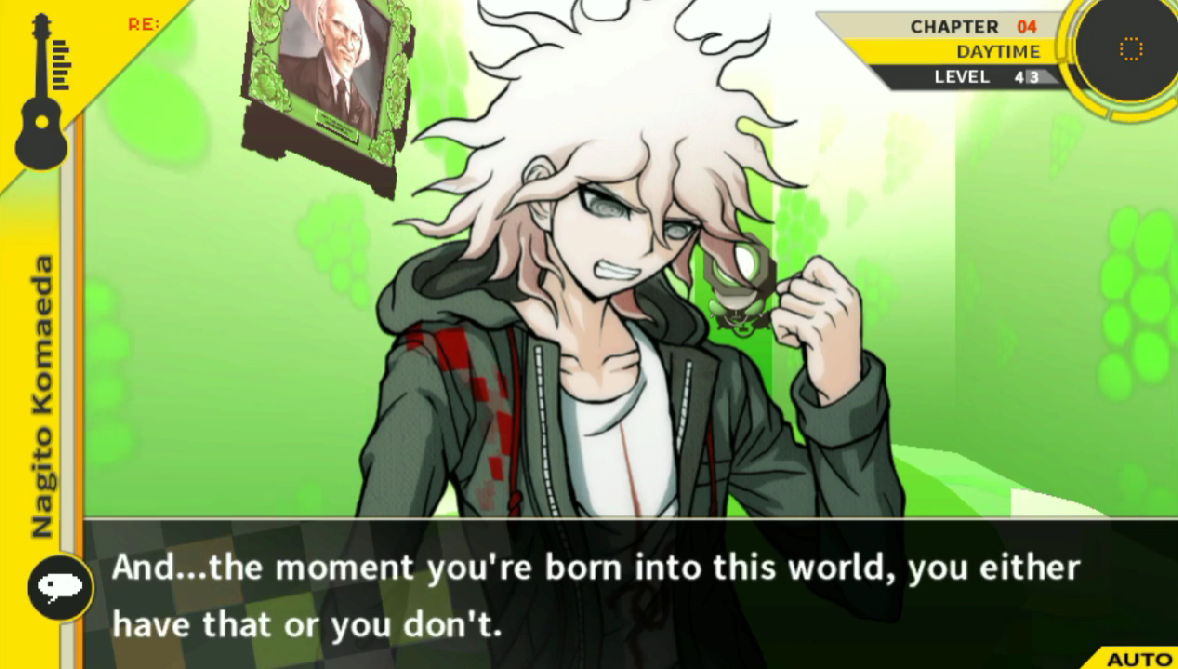
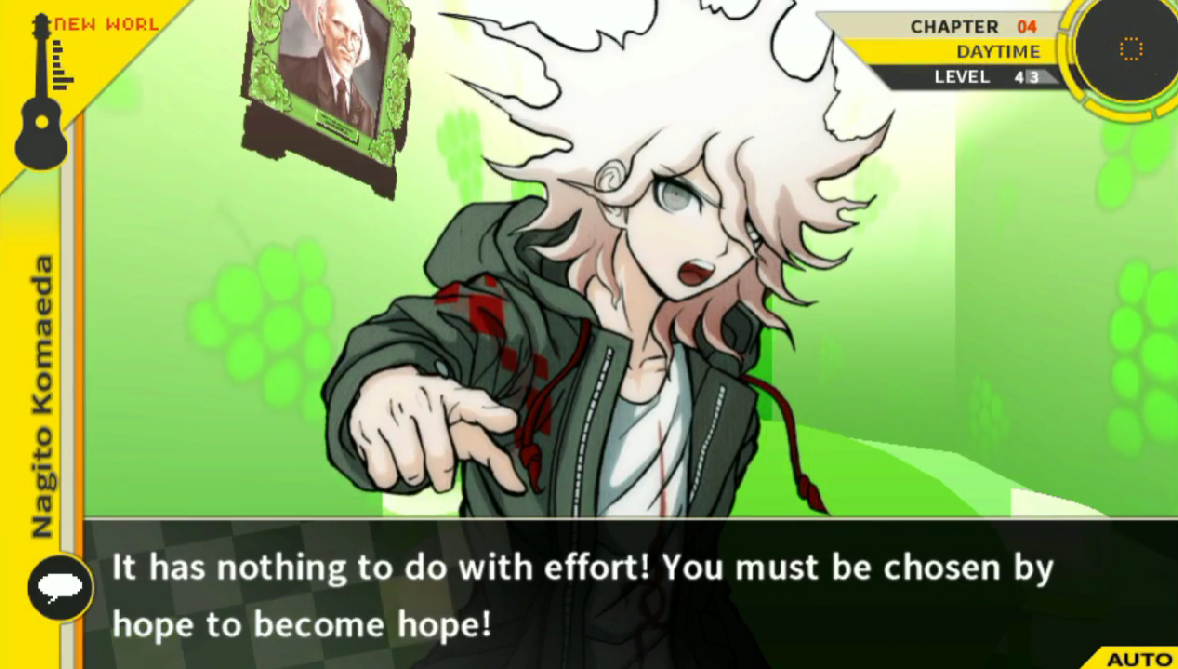
When supposedly talking about Hinata's lack of talent, but then when he talks about why Hinata is talentless, he says this:
 |
 |
|---|
Which is confusing. First, he's implying Hinata "perhaps" doesn't have a talent because he wasn't determined enough (meaning, he didn't work hard enough) only to then turn around and say having a talent/being hope actually has nothing to do with working hard, and it's about how you're born.
When I answer questions like these, I watch the ENG and JP version side-by-side, so I caught instantly what the issue was.
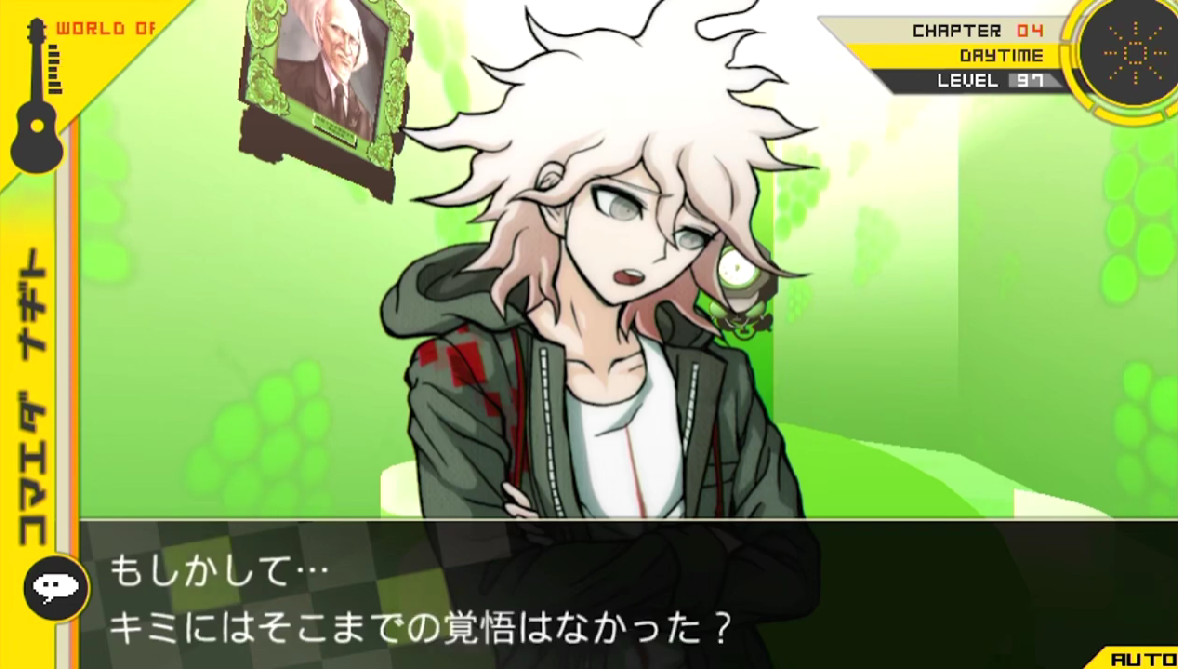
This line actually has nothing to do with talking about Hinata being talentless. In fact, I'm a little confused where they got this translation from. Keep in mind, the line before this is Hinata reacting to Komaeda dropping the information that he is from the Reserve course, saying: "Wh-What the hell...does that mean...?"—we will come back to this in a moment.
Let's look at the Japanese text upclose.
The first part, もしかして, is sound. This word means "maybe", "perhaps" etc. Our interest lies in the second part of this quote, specifically in そこまで, and 覚悟.
覚悟, even defined by ENG dictonaries, will often mean "prepared, readiness". While "determination" is listed as a definition on ENG dictionaries, I believe this is slightly misleading as determination, in English, is often a word for "conviction", while with 覚悟, being "determined" here is the type of determined that implies forethought, focusing on the aspect of having a goal mapped out (e.g. "I am determined to" = "I plan to").
To add, そこまで here means something like, "This much". This word is extremely flexible when it comes to wording in English, but the gist is, it shows the limit of something in sentences like "It is not that hard", "Don't take it that far".
Combined with that earlier context of Hinata being shocked, I believe the line is supposed to read:
| KOMAEDA: Perhaps...you weren't prepared for this to be the answer.
A literal translation would be, "Maybe, you were not prepared for it to be to this extent", meaning that Komaeda is remarking that Hinata likely was not prepared for the answer behind his missing talent to be so bleak and unfortunate (for it to go this far). I just tweaked it to sound more natural.
So, in essence: he was not commenting on Hinata being unable to get into HPA, he was commenting on his shocked reaction.
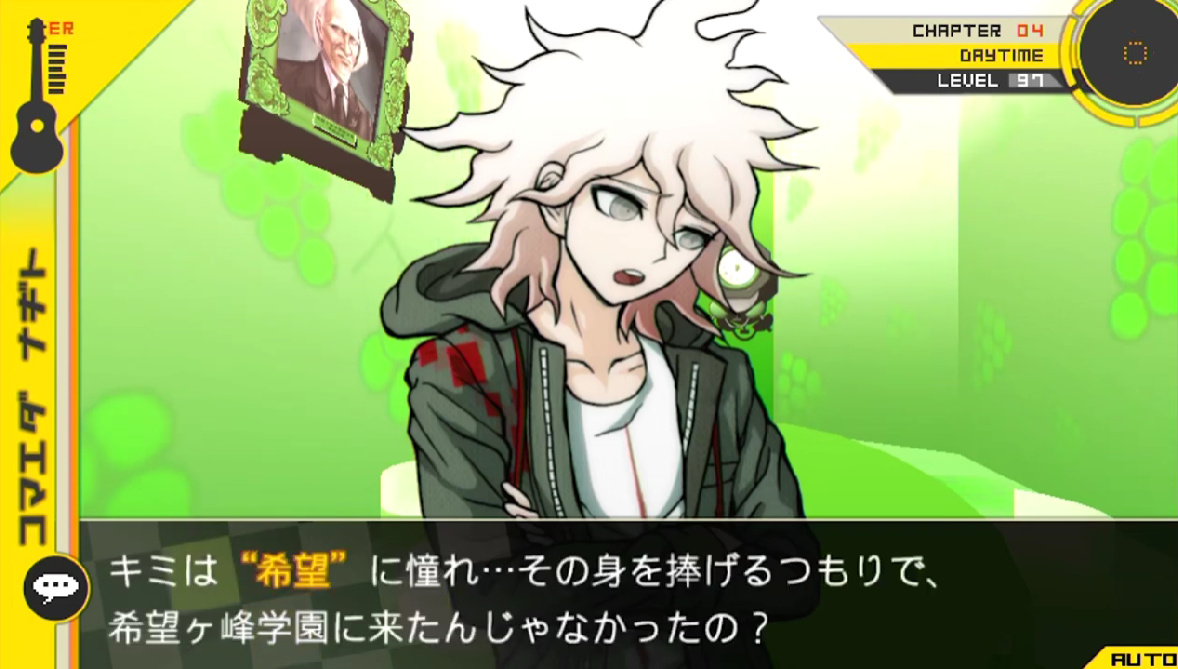
Let's move on to the part actually asked in the question.
 |
 |
|---|
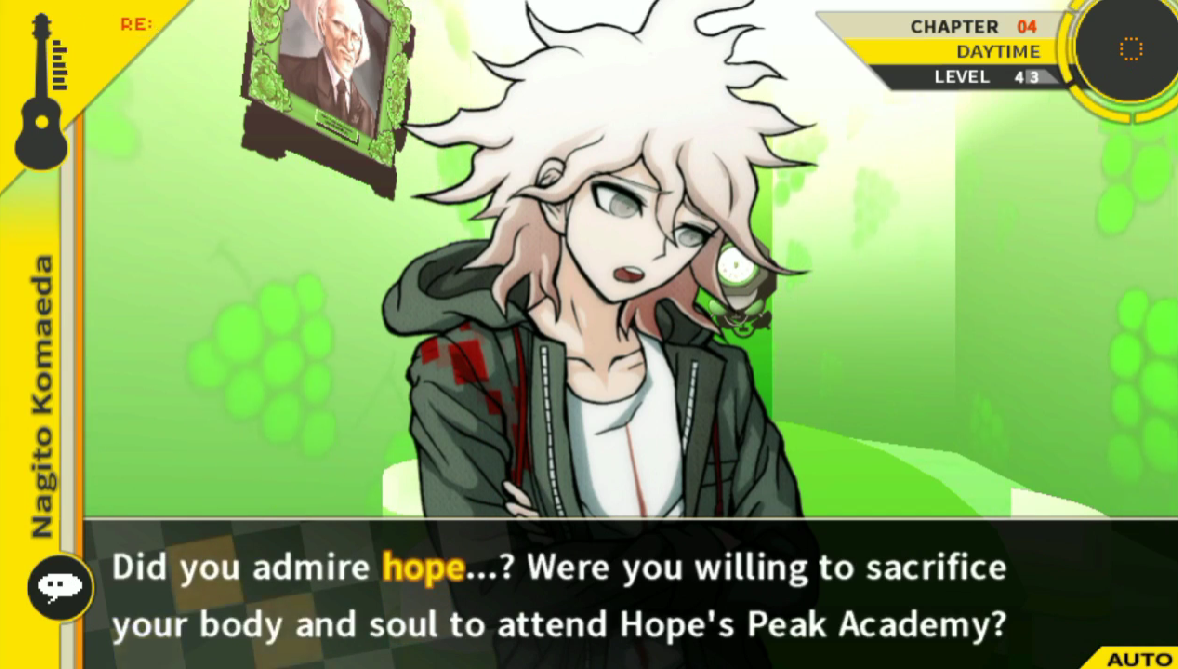
I actually kind of like the ENG translation. It's more liberal but in a good way. I'll provide a more literal translation in this case to better explain.
| KOMAEDA: You yearn to posses hope...so you entered Hope's Peak Academy with the plan to devote yourself to that goal, isn't that so?
My only qualm with the official translation is a nitpick; "admire" is not how I would put it...I don't think?
I may be wrong, but in English, "admiring" something doesn't always mean you want to be it. I hear a lot, "I admire his ability to do such hard work" and such. It sounds like you hold a lot of praise for him, but you could never do that yourself. "I admire firefighters, I'd never want to put my life on the line like that" and stuff...
憧れ is better thought of as "aspire", I think. It has the nuance of you want to embody it. "Admire" works, but it's the kind of admiration where you want to be that, too.
Besides that, "Were you willing to sacrifice your body and soul" is a very powerful way to write 「その身を捧げるつもり」, and I really have to give it to the team for this one.
Literally speaking, その身 means "That body", but 身 is an abstract way to refer to a person's self. その then makes it "one's self", and it can sound rather grandiose, at least to me. Thinking on it, I think it's due to the fact that 身 is very versatile and can represent both the physical body and the person themselves. I admit this is greatly context dependant.
Point is, turning その身 into "your [very] body and soul" is a perfect way to put it in this situation. 捧げる has an equal level of importance in feeling, it's like wholly dedicating everything to one thing. Sacrifice is apt.
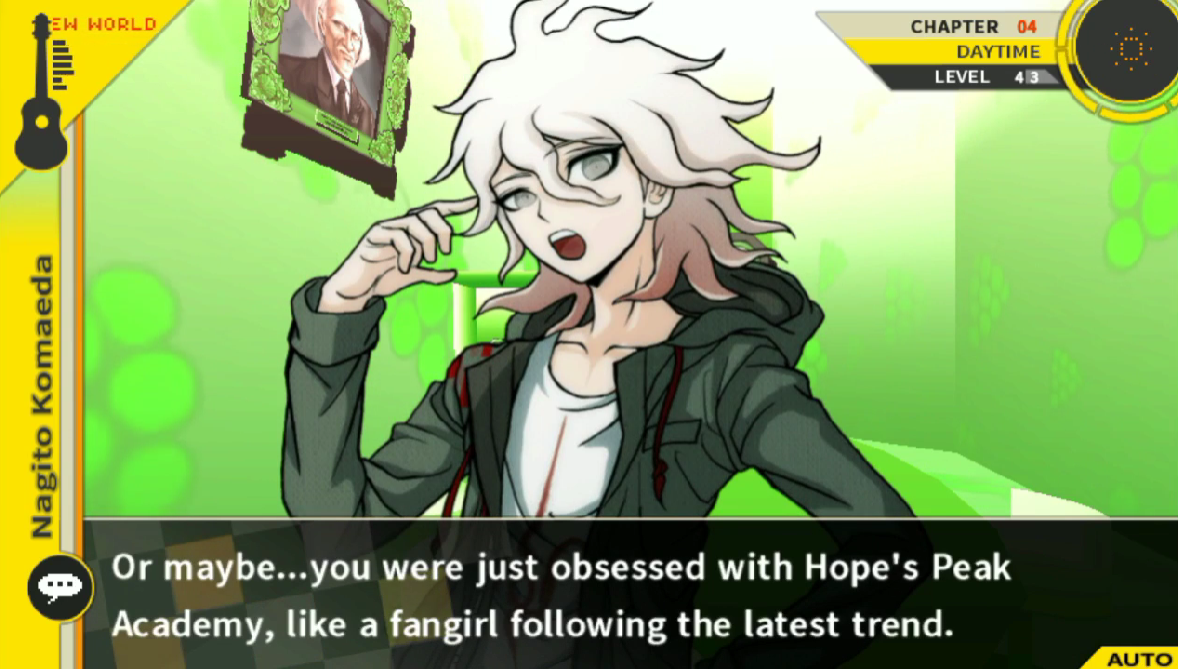 |
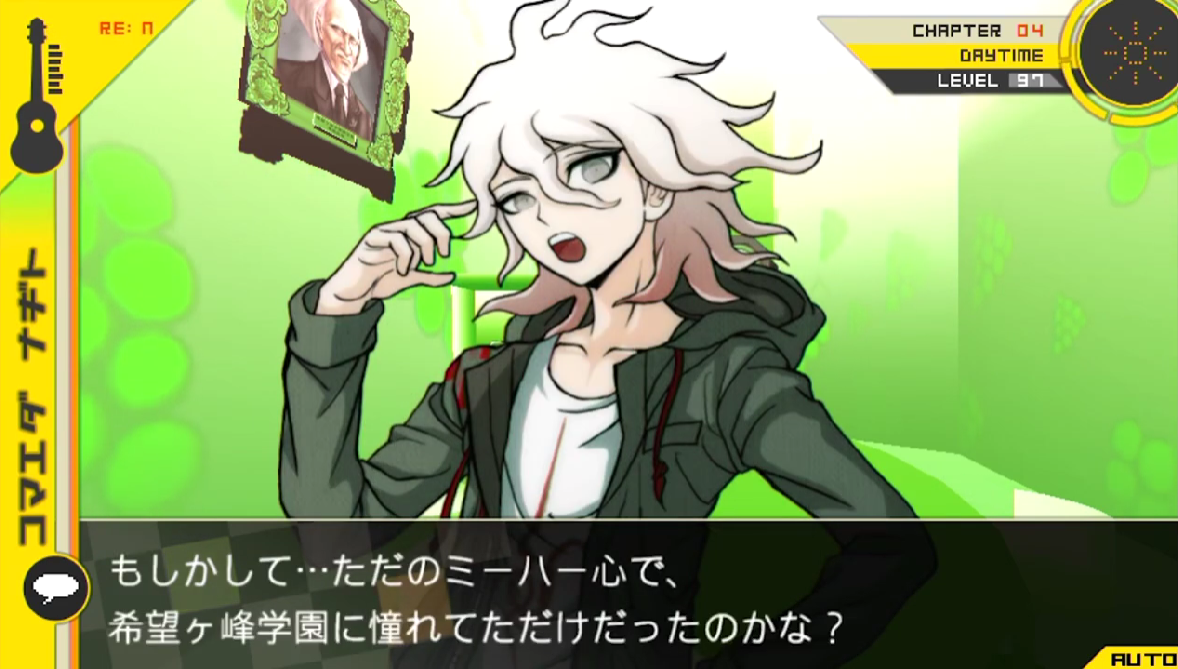 |
|---|
This translation is also fine, but I wrote my own version too.
| KOMAEDA: Or maybe...you were just a mindless sheep who looked up to Hope's Peak Academy [because everyone else was doing it].
Hinata then interjects, saying, "That's not why I joined at all!" (In the Official translation, he says "I-It's not like that! I...!")
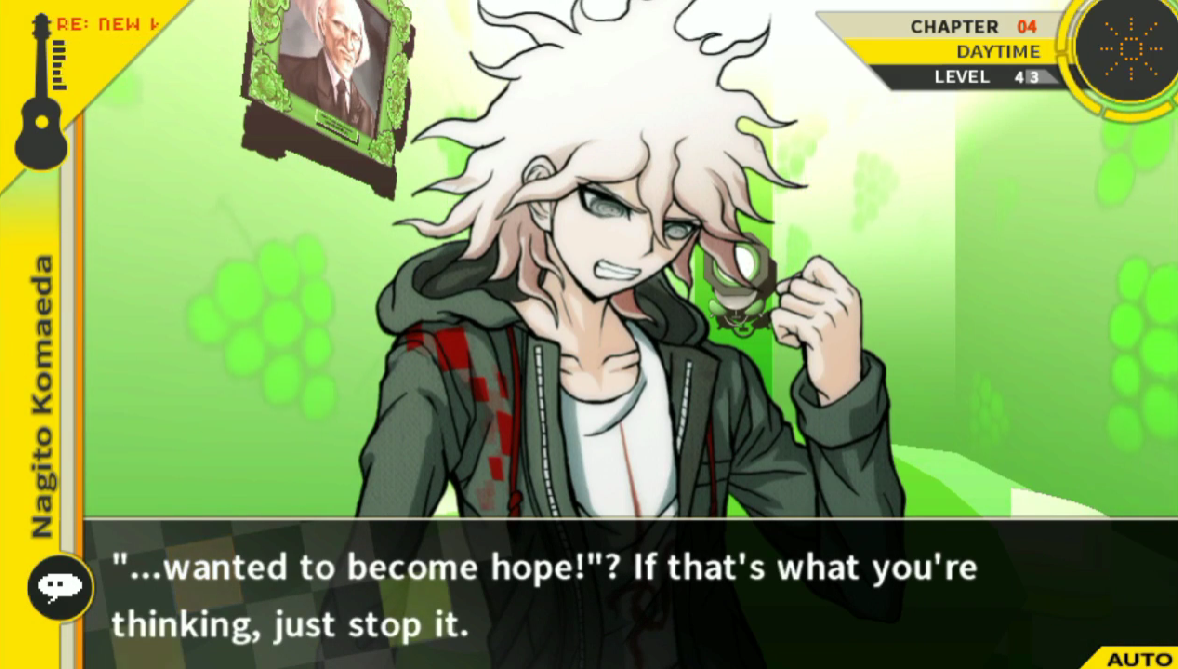
And then Komaeda replies:
 |
 |
|---|
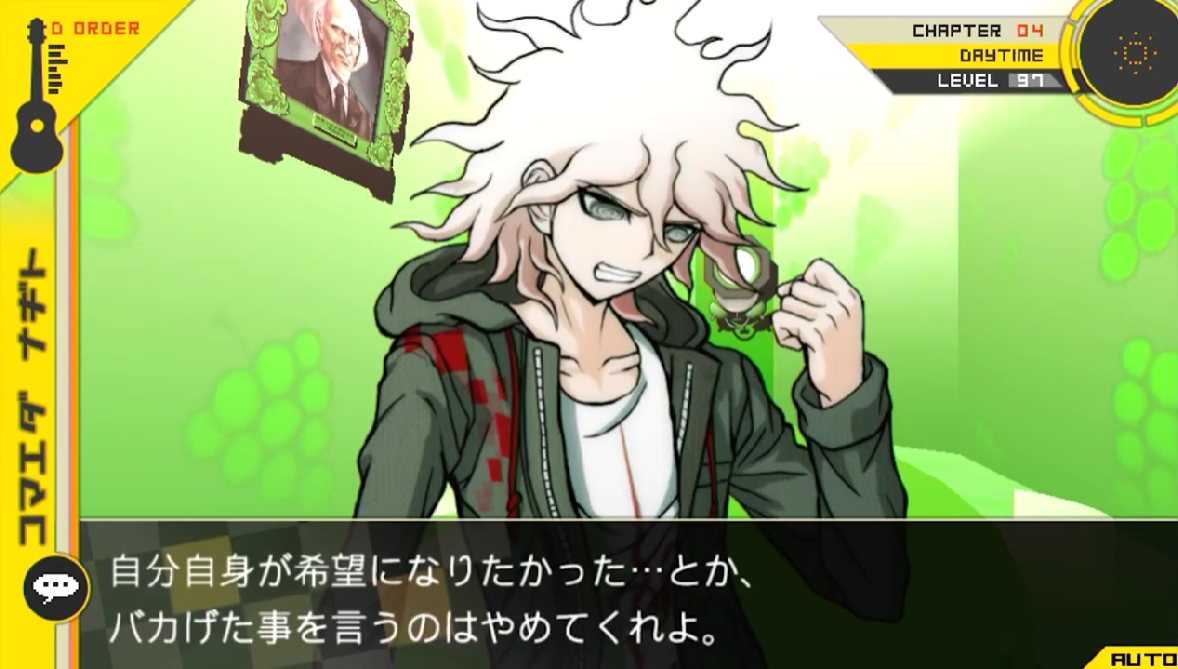
| KOMAEDA: No, it's because you "wanted to become hope yourself" or something like that. Seriously, quit saying such idiotic things!
As you can see, there is some minor differences in nuance here, so let me explain.
In the Japanese version, Komaeda "quotes" Hinata (that is, assuming what he was to say), as referenced by 「…とか」, where と is a quotation particle, and か means, "something like that" when paired with と. Since this is how Komaeda opens the sentence, NISA kept Hinata's dialogue literal so Komaeda could "finish the thought" for him. For what it's worth, this is a perfectly fine and clever way to go about it. My translation takes a slightly different direction, as technically, prior, all Hinata does is refute Komaeda's claim and trails off with 「俺はっ!」, which is ambiguous enough that we can assume what he meant (in my eyes, that he was refuting Komaeda's then just spoken claim that he joined just to be part of a fad) so I just had Komaeda counter back with what he assumed Hinata was thinking. I would not say my or NISA's versions are more accurate to one another in this situation.
The second part, however, I do think there was some missed nuance.
In response to his own quote of what he assumes Hinata is thinking, he says 「バカだけ事を言うのはやめてくれよ」We can break this down into several smaller parts.
バカ is a word I think a lot of people know, even if they can't read Japanese. "Baka" means "idiot/moron". After that is だけ, which means "only", in sentences like "only good things [nothing but good things]". Then, this is attatched to 事, which means "thing" as an abstract concept (not a physical "thing"). We can put this all together to mean: "only idiotic things".
The latter half, after the を particle (which signals usage of a verb, think something like popsicleをlick), has 言う, which means "to say/speak", and then の, which here is a particle that turns the entire sentence thus far into a noun. は after it marks it as a topic.
To put it simply...
- バカだけ事を言う -> "[to] say only idiotic things"
- バカだけ事を言うの -> "saying only idiotic things"
- バカだけ事を言うのは -> "in respect to [you/Hinata] saying only idiotic things[...]"
We finally reach the end, which is simply やめてくれよ. やめて is the connecting form of やめる, "stop". くれ is a forceful way to say "give this/do this for me", and よ is a sentence ending particle that is used to show emphasis, explanation, and such. Here, we can think of it as "driving the point home".
So, literally speaking, we can look at this as:
| KOMAEDA: in respect to [you/Hinata] saying only idiotic things, stop doing it.
However, recall that くれ is rather forceful-sounding, and is not a form I hear Komaeda say often because of this aspect. We also have to combine with this the よ particle which adds even more emphasis. Thus, I chose to translate it as "Seriously" and よ as an exclamation point. I think NISA's way about it was making Komaeda use the word "just" in "just stop it", but I personally feel this isn't as strong as it could be, and furthermore, they dropped the line about Komaeda calling Hinata's (well, Komaeda's projection of Hinata...) words idiotic/stupid.
Right after that, there is yet another mistranslation, albiet minor. I actually missed this the first time I covered this scene a year ago. But now that I'm revisiting it, I happened to catch it.
 |
 |
|---|
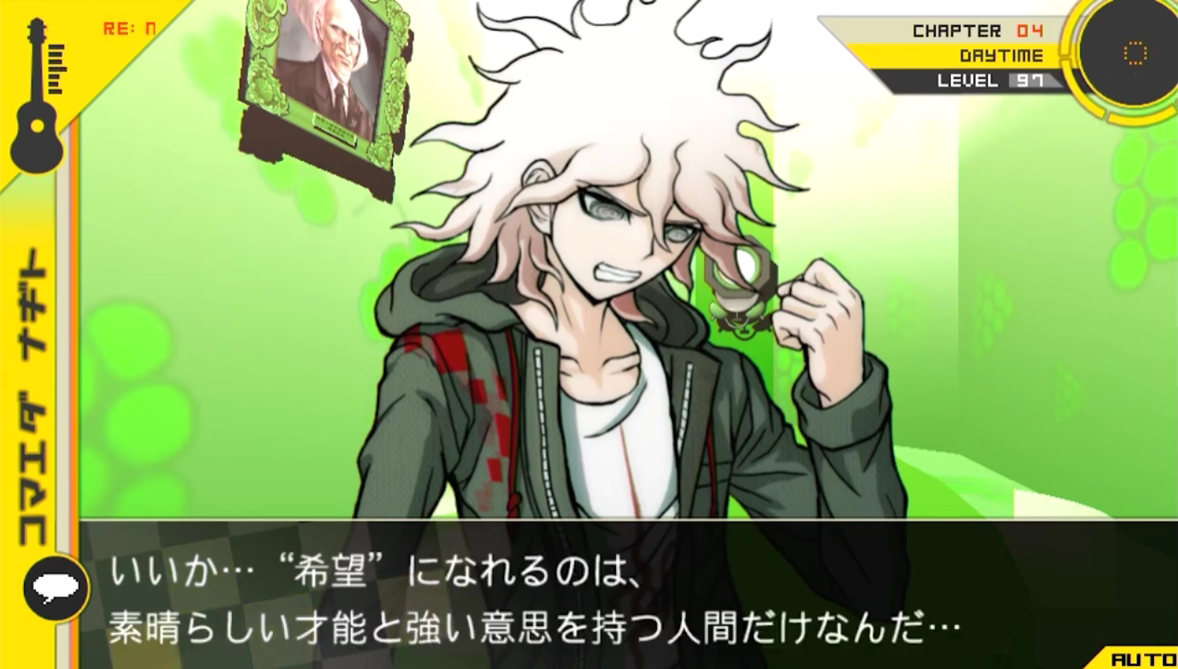
It is not a mistranslation in the usual sense. Rather, the English version adds a word that does not exist anywhere in the Japanese text. It is specifically the part where Komaeda says, "The only humans worthy of becoming hope[...]"
Again, while technically minor, I think this choice in wording can give the wrong impression. To have Komaeda declare what makes somebody "worthy" of becoming hope makes it sound no longer like a straight fact, but rather, a matter of opinion to him. And while Komaeda is very opinionated on many things, the topic at hand here is one of Komaeda explaining logistics, not his opinion. That is to say, even if this were Komaeda's opinion, he views it as a fact, and treats it as such.
This sentence's structure is actually very similar to that of the one we just looked at, where several words are modifying the attributes of another. Before, it was "only idiotic" clarifying the word "thing(s)". Here, we see the same in the line 「素晴らしい才能と強い意思を持つ人間だけなんだ」
We can break this down like we did before:
- 素晴らしい (adj. amazing, incredible) + 才能 (noun. talent) = "amazing talent"
- 強い (adj. strong, powerful, upstanding) + 意思 (noun. determination, will) = "strong determination/strong will"
- 持つ (verb. to posses, to own, to have, to hold)
- 人間 (noun. people, humans)
- だけ (particle. only, just)
The particles in this sentence are を (as mentioned before, this is the verb particle) and と again. Except, here, it is not being used as a quotation particle. When と is placed between two nouns (in this case, 素晴らしい才能 and 強い意思), it acts as a connector and thus means "and".
Putting it literally, we can read this as:
| Humans [who] posses amazing talent and strong will.
And, looping back to the first line, we can read the part where hope is mentioned, 「"希望"になれるのは」
Please recall what we discussed earlier for の and は—they are being used the same here, with の acting to make the phrase before it a noun, and は marking the topic, that being 「"希望"になれる」
希望 is, of course, "hope", and (に)なれる is the verb which means "(to) become". So, like before...
- 希望になれる -> "become hope"
- 希望になれるの -> "to become hope"
- 希望になれるのは -> "in respect to becoming hope[...]"
Which leaves us finally with:
| In respect to becoming hope, only humans [who] posses amazing talent and strong will [qualify].
There is no mention of being worthy in here. Now, you could make the arguement that the "worthy" part is a result of how んだ was chosen to be translated, as this is a fairly versatile particle. Since it is super situational, the best I can say is, at its core, it implies something beyond just spoken words, like an emotion or additional context. In my opinion, I think this particle here refers simply to the unspoken conclusion for why Hinata does not embody hope (as that is what this whole conversation is revolving around, after all); saying, "to be hope you must be born with these specific qualities (which is why you aren't hope, Hinata-kun!)"
This is very opinionated, and I'm sure other people will have their own takes on what んだ signafies here. But, in no reading do I personally believe it would wind up as "being worthy of"—that just makes little sense to me.
Moving on, we get this line:
 |
 |
|---|
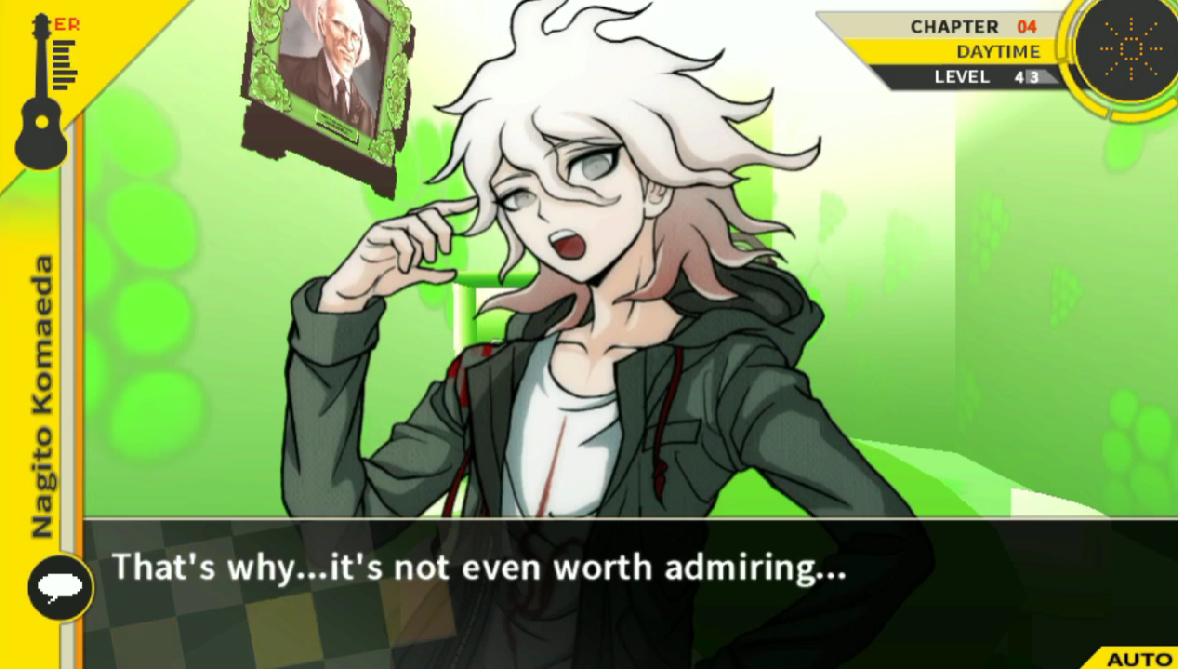
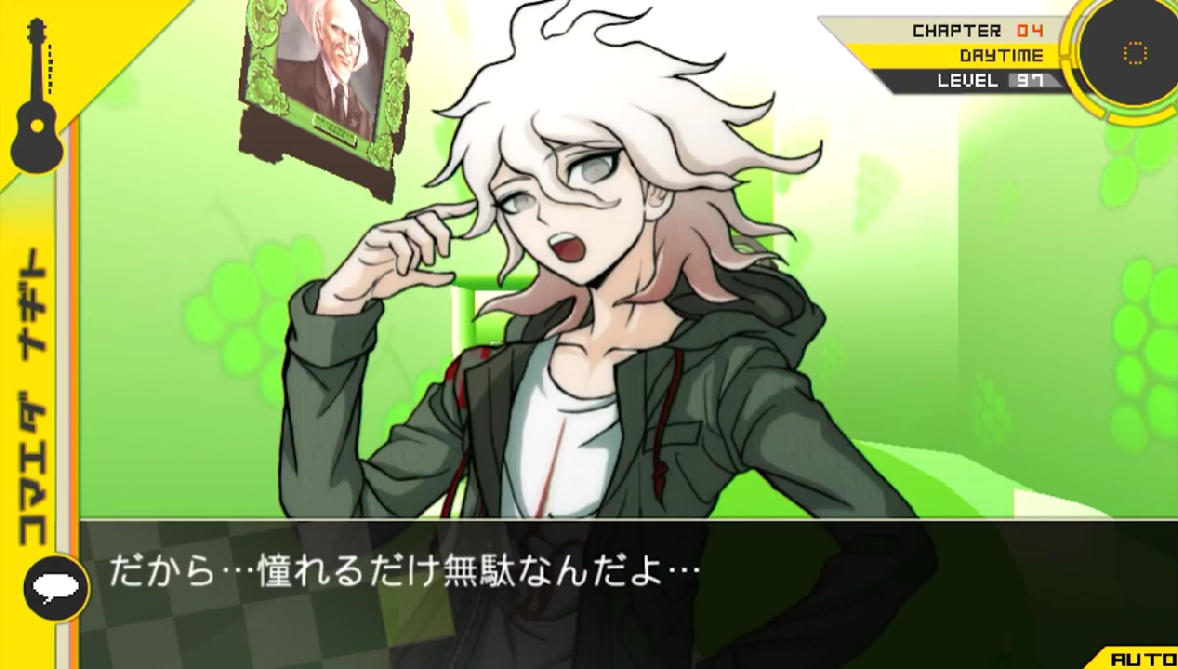
I think it's pretty obvious that it's a mistranslation even in English because it reads like a totally unrelated non sequitur. In Japanese, it makes a lot more sense. I don't quite know how they got this one wrong, however (my only guess is being rushed to translate...which is sadly likely).
We see the return of だけ here. Recall, I explained だけ means "only" or "just" in a quantity-sense. For example, saying "it's just you" when you ask how many people have showed up to a party so far. It's just you; you're the only one.
Before that word comes 憧れる, another word we saw earlier! Do you remember what it means? If not, that's fine. It means "aspire".
Then after is a new word, 無駄. 無駄 means something along the lines of "wasted effort", and is used when describing something as a waste of time/money/effort in sentences like, "it's a waste of time to teach him" (implying "he" is unteachable; that doing so is futile).
As said, I wish I knew how they got this mistranslation, because as I have laid out with these words individually, I don't know how you get "It's not even worth admiring". Maybe, they saw 無駄 (not worth doing/worthless to do) attatched to 憧れるだけ, and read that to say "not worth only admiring", or something...
That aside, let me provide you along the lines what it should say:
| KOMAEDA: That's why...just "aspiring" [to be something] isn't enough.
This is the translation I wrote about a year ago, and while I consider it accurate, I think this could be naturalized better in English yet to flow better. Plus, I admit for a "direct" translation, it's a bit more loose. If I wanted to be more literal, I could write, "That's why...aspirations alone are meaningless."
But, back to making this sound more naturalized. Komaeda is quite critical at this point; both the sprite art and direct words reinforce this. Including the usage of んだ, which as said earlier, implies something more. Here, I believe it to be acting as emphasis on Komaeda's explanation (especially coupled with よ), sort of like saying, "So, as you can see..."; it just makes it sound important. Given that, if we wanted to be more loose with our wording, we could also go with:
| KOMAEDA: Simply wishing for it to happen is a fool's errand.
This translation is less direct and instead takes the gist of what Komaeda is saying and rewords it to flow better in English while retaining the tone, and I do believe it is one of many ways you can take this line. This is where a translator's preference comes into play, and if I were writing a genuine English adaptation of a script rather than writing a blog post giving explanations, I would likely go with something along these lines, since the purpose of translation, to me, is to retain the faithfulness of a piece while also presenting it in a natural manner into the target language. But, out of the three different ways to word this sentence I've provided, I'm sure those of you reading have your own preference to which you like better. And these are only my takes on it! I'm sure other translators would come up with their own wordings.
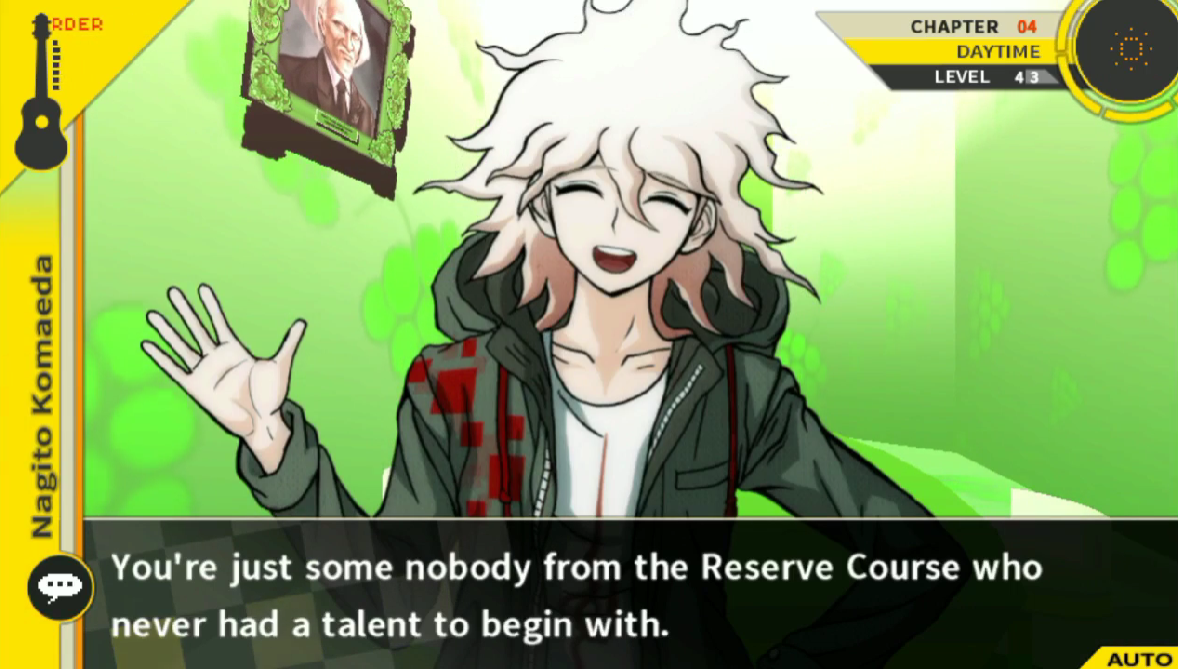
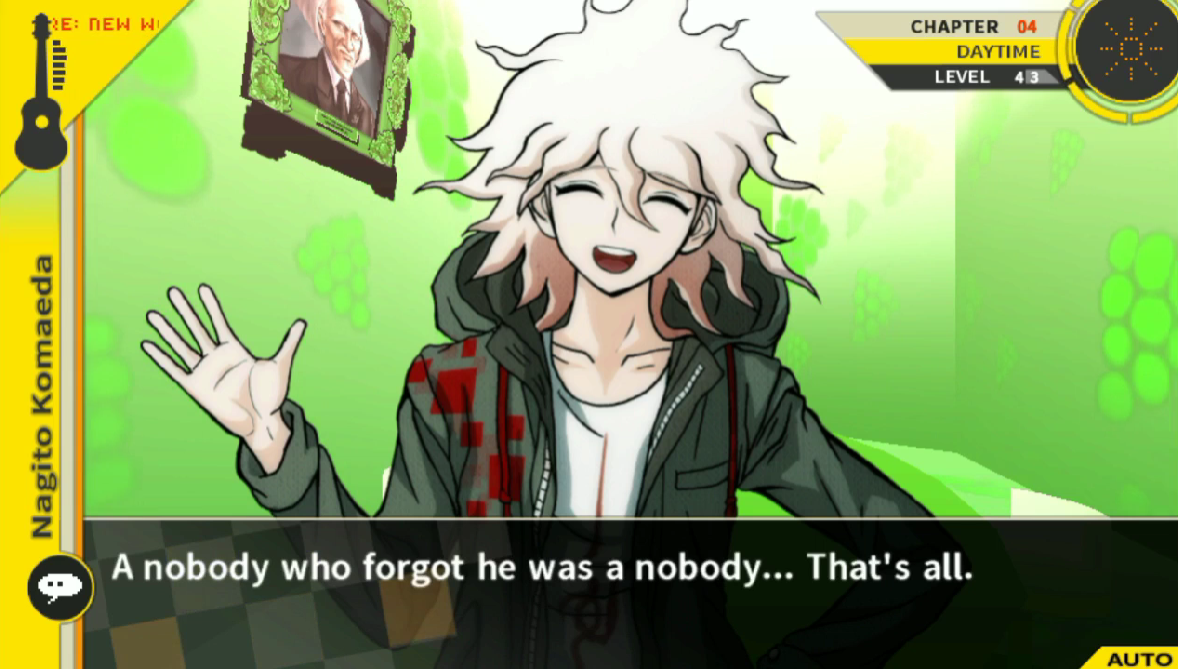
Only 2 lines later, we get these lines:
 |
 |
|---|
Which are, weirdly, way meaner than they are in Japanese.
 |
 |
|---|
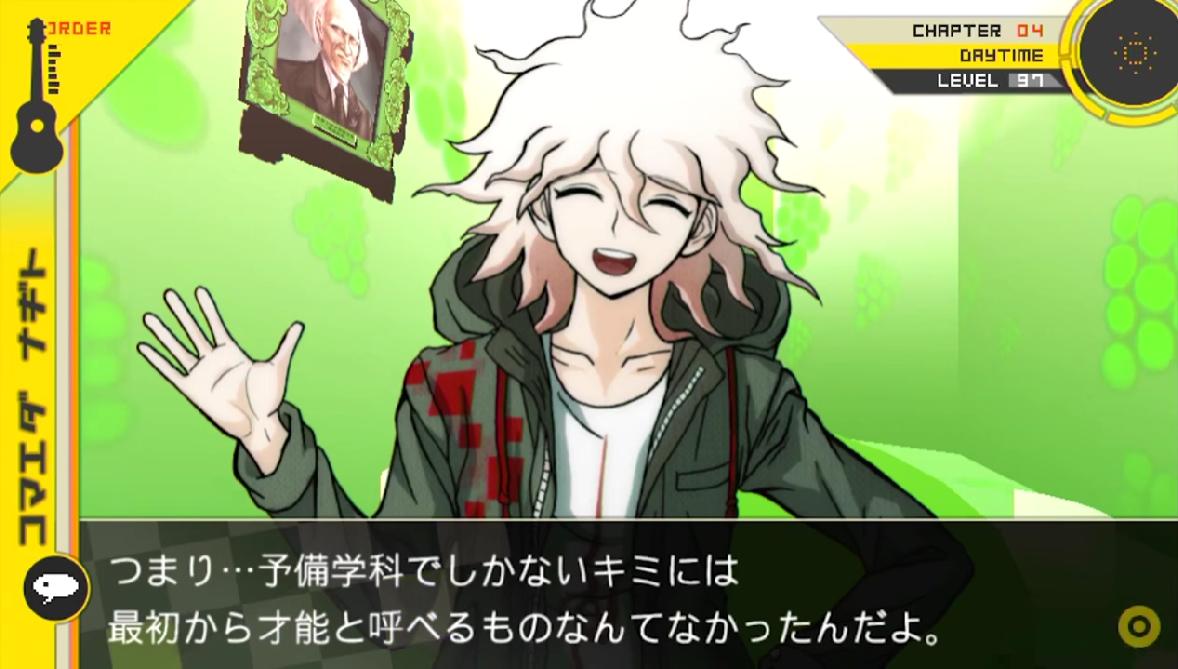
| KOMAEDA: In short...you're nothing more than a Reserve Course student who never had a talent to begin with.
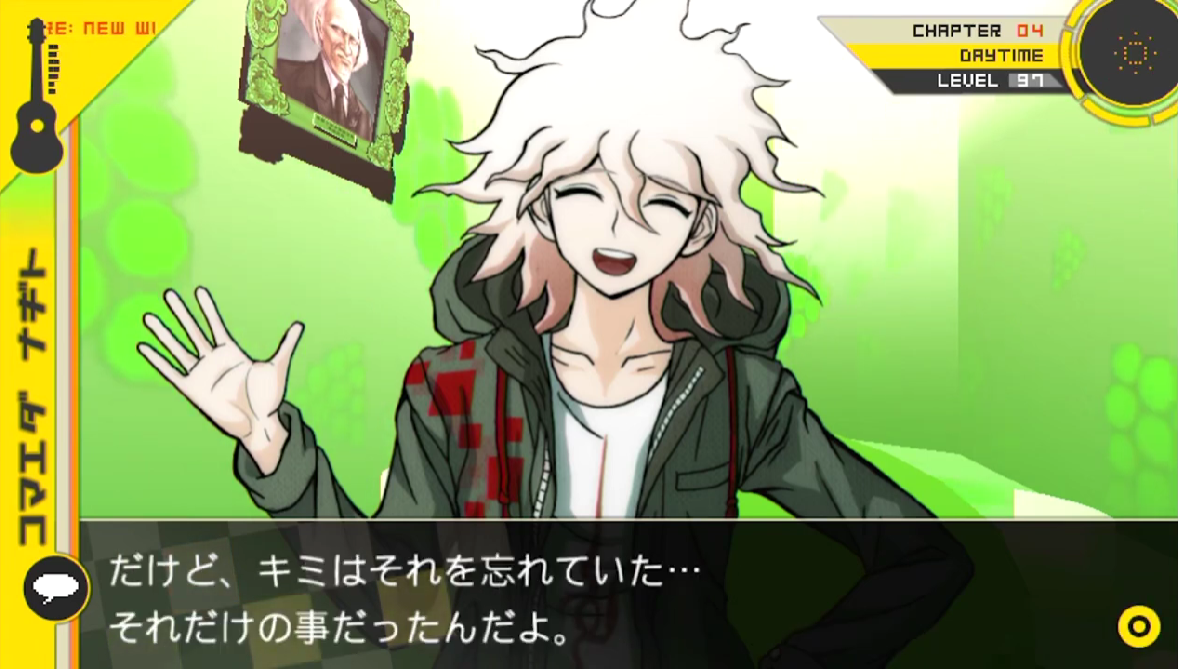
| KOMAEDA: You just happened to forget. That's all there is to it.
Specifically, my point is how Komaeda keeps calling Hinata a "nobody" in this section. In the first screenshot, the closest is 予備学科でしかない (in 予備学科でしかないキミ, in which 予備学科でしかない is modifying キミ ("you")), where でしかない has a negative connotation to it. So, it's saying "you are merely just a Reserve Course student" with a bit of an edge, but that's it. I guess this could be read as "a nobody from the reserve course" if you interpreted it in the meanest way possible. It's not necessarily wrong; it's up to the reader to decide how "mean" Komaeda intends it to be I suppose. A bit of ambiguity.
The second, however, does not use this phrase or anything like it.
Komaeda says, 「だけど、キミはそれを忘れていた」, which we will once again break down.
- だけど (particle. however, but)
- キミ (noun. you)
- それ (noun. that)
- 忘れていた (verb. forgotten, forgot)
And, as said earlier, all は does is mark the topic, with を marking an action a verb is taking. In this case, それを忘れていた, meaning the action of "forgot" is being done upon "that". It sounds kind of weird when I type it out like that, so I'll just write out the full sentence:
| However, you forgot that.
I'm unsure why this simple phrase was turned so hostile. Perhaps to keep consistency with the earlier translation. And to be clear, I don't even hate the Official translation's interpretation. I find it to be a genuinely interesting and valid angle, but with that said, I don't personally agree that Komaeda's tone is nearly that agressive in these particular lines.